A journey into a seasonal alchemy of salt and tide, where endangered life breathes, breeds, and thrives on the edge of a white-cracked desert carved by the Arabian Sea.
The land where the sea becomes salt
You do not merely arrive in the Little Rann of Kutch; you dissolve into it. Located in the northwestern corner of Gujarat, India, this vast 5,000-square-kilometre salt marsh is a geographical illusionist. Millions of years ago, this land was an extension of the Arabian Sea. Over millennia, geological shifts cut off the inlet, trapping a shallow watery basin.
Today, a seasonal cycle dictates its life. Every monsoon, the sea and local rivers flood the plains. But as the fierce desert sun takes over, the water recedes and evaporates, leaving behind a blinding, white-cracked crust of pure salt. It is a prehistoric landscape that defies the traditional definition of a desert. It is an ecotone, a rare, transitional zone and a living, breathing biosphere that encompasses the lesser-known Indian Wild Ass Sanctuary. Here, life does not just survive; it thrives through a seasonal alchemy of mud and tide. Standing here today, I looked out at a featureless, surreal topography where the horizon line completely vanishes, blurring the boundary between earth and sky.
This article might contain affiliate links. Read the disclaimer about affiliate links & PR gifting here.
This trip was hosted by The Fern Sattva Resort, Little Rann of Kutch who did not review or approve this story.

My desert sanctuary: The Fern Sattva Resort
Perched right on the edge of this stunning, rugged wilderness, I found the ideal base for my explorations at The Fern Sattva Resort, Little Rann of Kutch, Series by Marriott. Instead of just talking about eco-friendly ideas, the resort actively practices them. During my stay, I learned that they harvest rainwater, run on solar power, recycle their waste, and strictly limit plastic use, making my journey feel genuinely responsible.
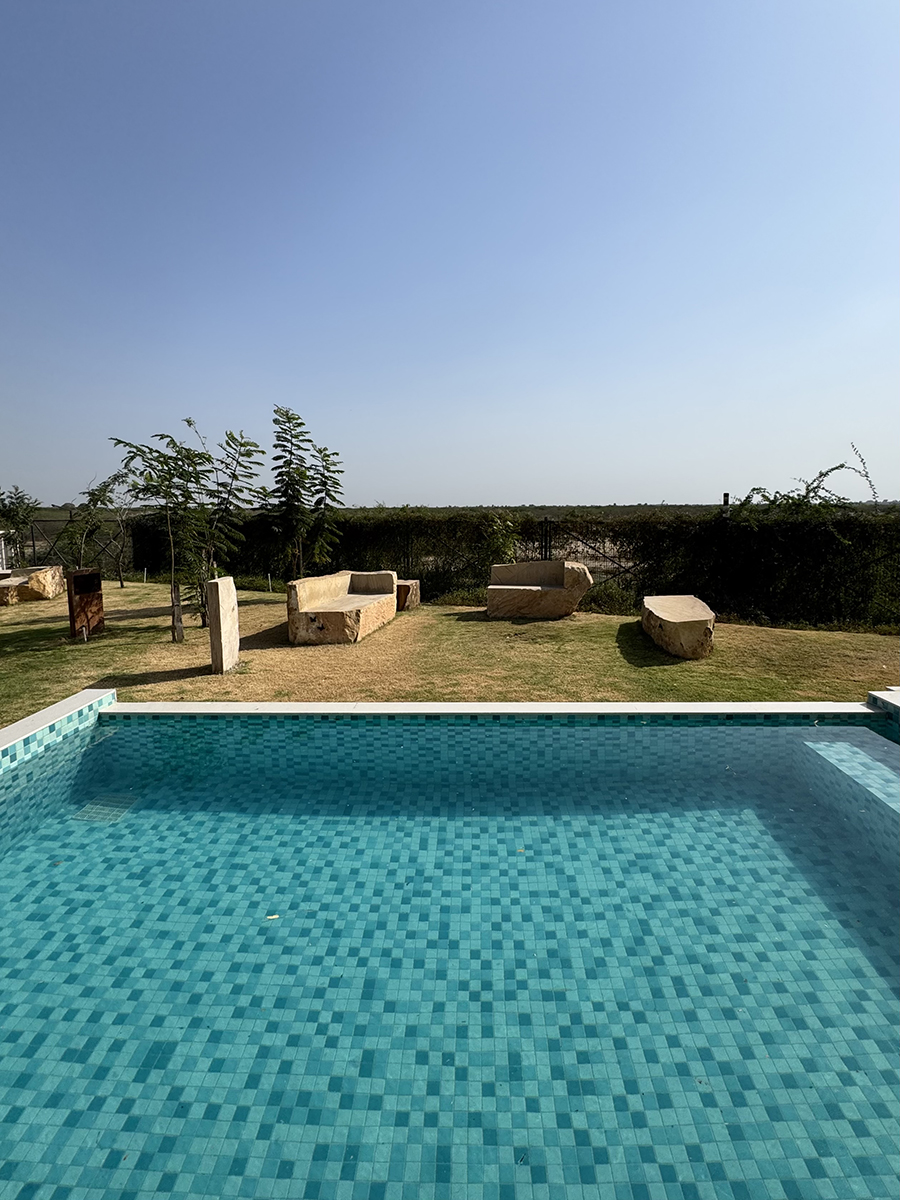
The layout, shaped by ARK Reza Kabul Architects, felt exceptionally built to spoil, yet it managed to blend up-to-date amenities with a warm, rustic charm. The room’s interior elements, from the organic timber finishes to the dim, warm lighting seemed to imitate the raw desert tones outside carefully. My room featured a Bougainvillea garden where a curious spiny lizard often darted out to visit, an open-air bathroom where I could count the stars during a night bath under the desert sky, and a veranda with a pool. The thoughtfully designed villas clustered around a central lily pond, built to lower the resort’s environmental footprint, gave me a quiet place to unwind and sleep to the sound of the cattails as the wind blew through them.
In the afternoon, hungry, I headed over to Dune, the resort’s main dining spot. The menu pays true homage to the region, balancing familiar international choices with authentic local Gujarati flavours. For lunch, I sat down to an incredibly comforting, rustic meal of Aloo Baigan shaak, a rich, spiced curry of potatoes and eggplant, which I scooped up using hot, fresh rotis. To beat the intense afternoon heat, I paired it with a cold, tangy glass of spiced buttermilk, known locally as chaas. That warm, satisfying meal provided the ultimate sensory contrast to the raw, windswept wilderness waiting just outside the resort property.


The Fern Sattva Resort, Little Rann of Kutch, images by Nupur Singh.

The sunset safari: Into the salt’s silhouette
My true immersion began in the cooling late afternoon as we climbed into an open-top, four-wheel-drive safari jeep alongside my expert naturalist guide, arranged by The Fern Sattva Resort. The engine rumbled to life, and we left the paved roads behind. The tire tracks crunching softly over the fragile, saline earth as we tracked deeper into the heart of the salt world. The cracked clay hexagons beneath my feet stretched out uninterrupted for miles, a geometric masterpiece carved entirely by the elements.
Suddenly, a wild boar bolted from the brush, running swiftly across our path and kicking up dust before disappearing into the arid scrub. As the afternoon shifted, I witnessed the region’s famous “pink horizons.” Thousands of migratory lesser flamingos, pelicans, cranes, and storks blanketed the seasonal water pockets, turning the horizon into a shimmering blush of pink and white. My naturalist cut the engine.
In the absolute quiet of this unparalleled birdwatching haven, my daughter suddenly raised her hand, stopping us mid-breath. Peering through her binoculars, she spotted a fierce Merlin, a compact, hyper-focused falcon known for its lightning-fast aerial hunts, perched starkly on a dead tree stump, while a majestic peregrine falcon rested quietly on the ground near a shrub nearby.


Just beyond it, our guide pointed to a much darker drama unfolding in the sky: a massive cinereous vulture was making a sudden, low sweep toward the ground. It was targeting an Indian Desert Fox pup, also known as the White-footed Fox. The naturalist explained that these animals are beautifully engineered for extreme climates, using their unusually large ears to shed body heat and pinpoint the faint rustles of underground prey. Fortunately, the pup darted into its den just in time. Turning our eyes back to the wetlands, the predatory display escalated as we watched a stealthy steppe eagle in action, powerfully conquering and eating a swan at the water’s edge.
As we rolled past the scrub, our presence froze a lone Indian Striped Hyena in its tracks. Caught in the open before dark, it erected its long spine mane, licking its jaws while locking onto our jeep with piercing, analytical eyes for a breathless second before vanishing into the thorns.
Right in the middle of these dynamic mudflats, a herd of the rare Indian Wild Ass emerged from the shimmering dust. I watched in awe as these magnificent, chestnut-coloured creatures sprinted effortlessly across the cracked earth, putting on a breathtaking display of the incredible speed and stamina that make them famous.
By now the air had cooled rapidly as my naturalist stopped near the wetland and I saw the sun melting like I have never before in hues of orange, pink and red. The vast white salt desert dissolved into a flawless, expansive mirror. The entire sky ignited. Out here, the standard metrics of time and distance simply evaporate. Looking out at the horizon, it became blindingly clear that this is no empty void; it is a complex, hyper-resilient landscape shaped by a quiet, majestic history, raw adventure, and an impossibly adaptive nature.


Images courtesy of The Fern Sattva Resort, Little Rann of Kutch.

Travel practicalities
- Getting there: Fly from Toronto or Vancouver into Ahmedabad (AMD), followed by a two-to-three-hour private drive.
- When to visit: October to March provides cool weather and peak migratory bird numbers.
- What to pack: Bring clothing layers for extreme temperature shifts, plus high-SPF sunscreen, a cotton scarf, and polarised sunglasses for the salt glare.
- Booking safaris: Arrange your jeep tours through the front desk at The Fern Sattva Resort, Little Rann of Kutch, Series by Marriott for certified naturalists.
- Private tours: Discover the Rann of Kutch on a 3-day private tour from Ahmedabad. Explore Kutchi villages, visit Bhuj’s palaces and enjoy a stay in Tent City with a guide.